
Packing for a cruise is different from any other type of vacation. You’re dressing for formal dinners, beach days, shore excursions, and pool lounging — sometimes all in the same day. Get it wrong and you’ll spend the trip either overdressed, underprepared, or paying inflated onboard prices for things you forgot.
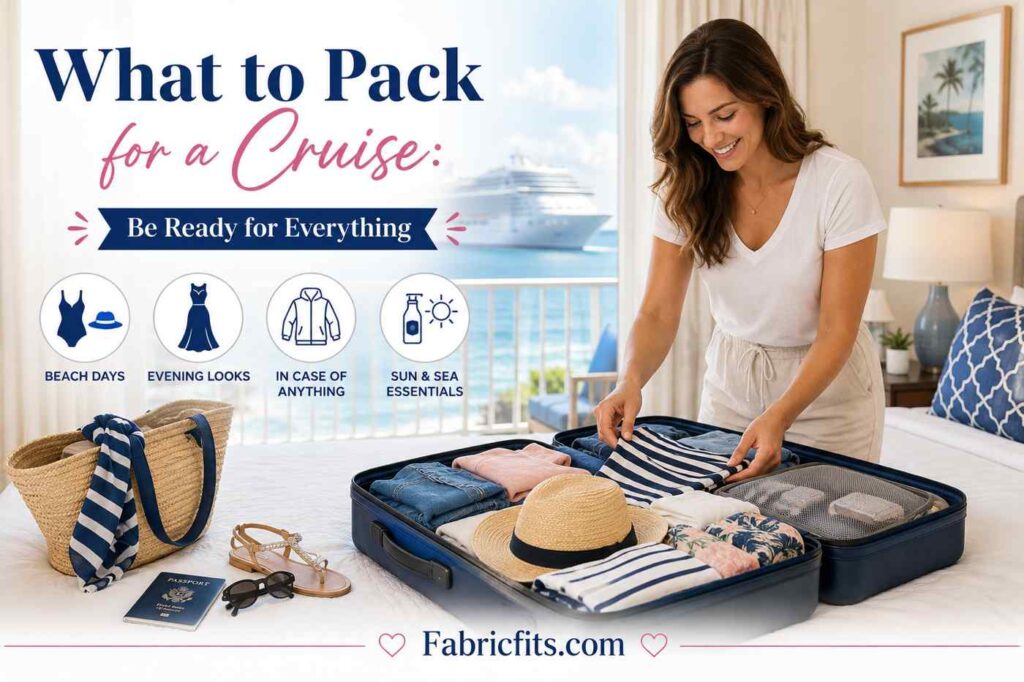
This complete cruise packing guide covers everything you need to bring, organized by category, so you can board with confidence and spend your time enjoying the voyage rather than wishing you’d packed differently.
Items to Buy for Your Cruise
- Hanging toiletry bag
- Magnetic hooks
- Packing cubes
- Portable power bank
- Waterproof phone case
- Travel-sized sunscreen
- Collapsible water bottle
- Over-the-door shoe organizer
- Motion sickness bands
- Lightweight day backpack
Clothing to Pack for a Cruise
Cruise packing requires more planning than a typical vacation because you need outfits for multiple settings — casual daywear, resort wear for ports, and formal or smart-casual attire for evenings onboard. Check your cruise line’s dress code before packing, as requirements vary significantly between mainstream, premium, and luxury lines.
Most cruises operate a mix of casual, smart-casual, and formal nights. Mainstream lines like Carnival and Royal Caribbean typically have one to two formal nights per seven-day sailing; luxury lines like Cunard maintain formal dress codes most evenings. Know your ship before you pack.
- Casual daywear tops (6–8) — Lightweight t-shirts, tank tops, and casual blouses for sea days, pool time, and casual shore excursions. Quick-dry fabrics are ideal.
- Shorts and casual trousers (3–4 pairs) — For daytime activities, port exploration, and casual dining. Linen and lightweight cotton are the most comfortable in warm climates.
- Smart-casual evening outfits (3–4) — For most evening dining. Collared shirts, chinos, or smart trousers for men; dresses, blouses, or smart separates for women.
- Formal outfit (1–2) — For formal nights. A suit or blazer with dress trousers for men; a cocktail dress, gown, or formal separates for women. Check how many formal nights your itinerary includes.
- Two swimsuits — Always pack two so one can dry while you wear the other. Cruise ships have multiple pools and hot tubs, and beach stops are frequent.
- Cover-up or sarong — Required when moving between the pool deck and indoor areas on most ships. Lightweight and doubles as a beach wrap at ports.
- Light cardigan or jacket — Ship air conditioning is consistently cold, particularly in dining rooms, theatres, and entertainment venues. Always have a layer within reach.
- Warmer layers for cooler itineraries — Alaska, Northern Europe, and repositioning cruises require genuinely warm clothing. A mid-weight fleece, waterproof jacket, and warm trousers are essential for cold-weather sailings.
- Workout clothes — If you plan to use the ship’s gym or fitness classes, pack two or three sets of activewear.
- Sleepwear — Lightweight and comfortable. Cabin temperatures are controllable but can vary.
Packing tip: Magnetic hooks are one of the most recommended cruise hacks. Cabin walls are magnetic steel, and hooks let you hang bags, lanyards, and extra storage anywhere on the wall — dramatically expanding your limited cabin storage space.
Footwear to Pack for a Cruise Vacation
Shoe selection is critical on a cruise because you need footwear that covers formal evenings, active shore excursions, beach days, and casual ship life — all in a bag that also has to fit your formal wear. Four pairs covers almost every cruise scenario without eating your entire luggage allowance.
- Comfortable walking shoes or trainers — Your primary shoe for shore excursions, city exploration, and active port days. Must be already broken in. Cobblestone streets in European ports destroy unprepared feet.
- Dress shoes or heels — For formal nights and smart-casual evenings. Choose something comfortable enough to wear through a multi-course dinner and an evening show.
- Sandals or flip-flops — For pool decks, beach days, and casual port stops. A pair with arch support works as casual daywear too.
- Water shoes — For rocky beaches, snorkeling excursions, and shore activities involving water. Lightweight and pack flat.
Toiletries & Personal Care for Your Cruise
Most cruise ships provide basic toiletries — shampoo, conditioner, body wash, and soap — but quality varies significantly by cruise line. Premium and luxury lines tend to provide better products; budget lines often supply the bare minimum. Bring your own preferred products in travel-sized containers regardless, and check what your specific cruise line provides before packing full-sized versions.
- Toothbrush, toothpaste, and floss — Always bring your own. Ships do not provide dental care items.
- Shampoo, conditioner, and body wash (travel-sized) — Or solid bars, which take up no liquid allowance and last the length of most cruises.
- Sunscreen SPF 50+ (generous supply) — Sunscreen onboard is significantly more expensive than at home. Bring far more than you think you need, particularly for Caribbean and Mediterranean itineraries with heavy sun exposure.
- After-sun lotion or aloe vera gel — Sea days involve long hours of sun exposure. After-sun care makes a noticeable difference to skin comfort in the evenings.
- Seasickness medication or motion sickness bands — Even experienced sailors can be affected in rough seas. Pack medication before you need it — the ship’s medical center charges significantly for the same products.
- Insect repellent — Essential for tropical port stops, particularly in the Caribbean, Central America, and Southeast Asia where mosquitoes carry serious diseases.
- Prescription medications (full supply plus extra) — Bring more than you need for the trip length. Ship medical centers carry limited medication, and running out at sea has no easy solution.
- Hand sanitizer and wet wipes — Cruise ships take hygiene extremely seriously, but having your own sanitizer for port excursions and market visits is practical.
- Lip balm with SPF — Sea wind and sun combine to dry and burn lips faster than most environments. Keep one in every bag.
- Feminine hygiene products (full supply) — Bring everything you need from home. Onboard shops carry limited stock at elevated prices.
Tech & Gadgets to Pack for a Cruise
Technology planning matters more on a cruise than almost any other vacation because internet access at sea is expensive and often slow. Download everything you need before you board — offline maps of every port, entertainment, books, and music — and set realistic expectations for onboard connectivity.
- Smartphone — Put it in airplane mode as soon as you board to avoid roaming charges, then connect to the ship’s Wi-Fi if you’ve purchased a package. International roaming at sea is extremely expensive.
- Portable power bank — Cruise cabins typically have limited plug sockets — often just one or two near the desk. A power bank keeps all your devices charged without competing for outlets.
- Power strip without surge protector — Many cruise lines allow basic power strips (without surge protectors, which are banned for fire safety reasons). A multi-outlet strip solves the limited socket problem entirely. Check your cruise line’s policy before packing.
- Universal travel adapter — Outlet types vary by ship nationality and itinerary. A universal adapter handles any configuration.
- Waterproof phone case or dry bag — For beach excursions, water activities, and tender boat transfers in choppy conditions.
- E-reader loaded with books — Sea days are perfect for reading, and an e-reader loaded with a dozen books weighs the same as a single paperback.
- Camera or action camera — Ports, wildlife, sunsets, and sea days all reward a quality camera. An action camera is ideal for snorkeling, water sports, and active excursions.
- Offline entertainment downloaded — Movies, TV shows, podcasts, and music downloaded before departure. Streaming at sea is unreliable and consumes expensive data packages.
Documents & Money to Pack for a Cruise
Document requirements for cruises are stricter than many other vacations because you are legally entering and exiting multiple countries. Missing documentation at a port can result in being denied entry and left behind while the ship continues — with no obligation on the cruise line to wait.
- Passport — Required for international cruises. Check validity requirements for every country on your itinerary — many require six months validity beyond your travel dates. Even for closed-loop US cruises (departing and returning to the same US port), a passport is strongly recommended over a birth certificate.
- Cruise booking confirmation — Printed and digital copies. Required at embarkation along with your passport.
- Visas (if required) — Research every port on your itinerary individually. Some ports require advance visas; others offer visa-on-arrival. Your cruise line can advise, but responsibility for valid documentation is yours.
- Travel insurance documents — Including the emergency contact number. Cruise-specific travel insurance that covers missed ports, cabin confinement due to illness, and emergency medical evacuation is strongly recommended.
- Credit card registered with the ship’s account — Most cruise lines operate a cashless onboard system where all purchases are charged to a card registered at check-in. Notify your bank before departure.
- Cash in local currencies for ports — Many port market vendors, local taxis, and small restaurants don’t accept cards. Small denominations of local currency make port days significantly smoother.
- Copies of all documents stored separately — One physical copy in a different bag and one digital copy in cloud storage or email. If your passport is lost at a port, a copy dramatically speeds up consular assistance.
Health & Safety Items to Pack for a Cruise
- First aid kit — The ship’s medical center is available but expensive. A basic kit covering bandages, antiseptic, blister pads, pain relief, and antidiarrheal medication handles the majority of minor health needs.
- Reusable water bottle — Stay hydrated on port days, shore excursions, and sea days without purchasing bottled water at every stop.
- Seasickness remedies — Medication, acupressure bands, and ginger chews each work for different people. Pack more than one type and discover what works for you before you need it urgently.
- Small flashlight or headlamp — Useful for early morning wildlife excursions, cave tours at ports, and navigating your cabin without waking travel companions.
- Lanyard for cruise card — Your cruise card is your cabin key, onboard payment method, and identification for getting on and off the ship. A lanyard keeps it accessible at all times and prevents the frequent problem of misplacing it in a cabin.
Read Next:
Cruise Packing List: Everything in One Place
Clothing
- Casual daywear tops (6–8)
- Shorts and casual trousers (3–4)
- Smart-casual evening outfits (3–4)
- Formal outfit (1–2 depending on itinerary)
- Two swimsuits
- Cover-up or sarong
- Light cardigan or jacket
- Warmer layers (for cold itineraries)
- Workout clothes
- Sleepwear
Footwear
- Comfortable walking shoes or trainers
- Dress shoes or heels
- Sandals or flip-flops
- Water shoes
Toiletries
- Toothbrush, toothpaste, floss
- Shampoo, conditioner, body wash
- Sunscreen SPF 50+ (generous supply)
- After-sun lotion or aloe vera
- Seasickness medication or bands
- Insect repellent
- Prescription medications (plus extra)
- Hand sanitizer and wet wipes
- SPF lip balm
- Feminine hygiene products
Tech & Gadgets
- Smartphone (airplane mode ready)
- Portable power bank
- Power strip (no surge protector)
- Universal travel adapter
- Waterproof phone case or dry bag
- E-reader loaded with books
- Camera or action camera
- Offline entertainment downloaded
Documents & Money
- Passport (check validity)
- Cruise booking confirmation
- Visas (if required for any port)
- Travel insurance documents
- Credit card for ship account
- Cash in local currencies
- Document copies (physical and digital)
Health & Safety
- First aid kit
- Reusable water bottle
- Seasickness remedies
- Small flashlight or headlamp
- Lanyard for cruise card
Frequently Asked Questions About What to Pack for a Cruise
What should you not pack for a cruise?
Cruise lines prohibit several items for safety and security reasons. Never pack: surge protector power strips (fire hazard — basic power strips without surge protection are usually permitted), irons and steam irons (ships provide ironing facilities), candles and incense, weapons of any kind, and in most cases, drones without prior written approval. Check your cruise line’s prohibited items list before packing, as policies vary and violations can result in items being confiscated at embarkation.
How many formal nights should I pack for?
It depends entirely on your cruise line and itinerary length. A standard seven-night mainstream cruise typically includes one to two formal nights. Longer sailings of ten to fourteen nights may have three or four. Luxury lines like Cunard have formal dress codes most evenings. Check your specific itinerary’s schedule and your cruise line’s dress code policy — this information is always available on the cruise line’s website and in your booking documents.
Do cruise ships provide hairdryers?
Most cruise ships provide hairdryers in cabins, but they are frequently low-powered travel models that take significantly longer to use than a full-sized home dryer. If hair styling matters to you, bringing your own compact travel hairdryer is worth the space. Check whether your cabin’s outlet type matches your dryer’s plug before packing — or bring a universal adapter.
Can I bring alcohol on a cruise?
Alcohol policies vary dramatically by cruise line. Most mainstream lines (Carnival, Royal Caribbean, Norwegian) prohibit bringing alcohol onboard beyond a limited allowance of wine — typically one bottle per adult at embarkation only. Premium and luxury lines tend to be more permissive. Attempting to bring prohibited alcohol onboard usually results in confiscation. Check your cruise line’s specific alcohol policy in your booking terms.
What should I pack in my carry-on for a cruise?
Your checked luggage is typically delivered to your cabin several hours after embarkation — meaning you’ll board the ship and spend the first afternoon without it. Pack a carry-on bag with everything you need for those first hours: swimwear and a cover-up to use the pool immediately, any medications you need during the day, your cruise documents and passport, valuables and electronics, and a change of clothes in case your luggage is significantly delayed.
Do I need travel insurance for a cruise?
Cruise-specific travel insurance is strongly recommended and arguably more important than for any other type of vacation. Medical emergencies at sea are expensive — helicopter evacuations and onboard medical treatment cost far more than equivalent land-based care. Cruise insurance also covers missed ports due to weather, cabin confinement caused by illness, and the specific costs associated with joining or leaving a ship mid-itinerary. Standard travel insurance policies often have exclusions that apply specifically to cruise travel, so read the policy carefully before purchasing.
How do I avoid seasickness on a cruise?
The most effective approach combines preparation and positioning. Book a cabin in the middle of the ship on a lower deck — this location experiences the least motion in rough seas. Pack multiple seasickness remedies and try them before the trip to know what works for you: antihistamine-based medications, scopolamine patches, acupressure wristbands, and ginger products all work for different people. Stay on deck in fresh air and focus on the horizon if symptoms begin — lying in a moving cabin typically makes seasickness worse rather than better.
A well-packed bag is the foundation of a great cruise. Get the essentials right — the right clothes for every occasion, the documents you legally need at every port, and the small practical items that make cabin life comfortable — and the rest of the experience takes care of itself.
The ship is waiting. Pack smart and enjoy every nautical mile.